How much house can I afford?
Buying a new home should be
exciting but it should also provide you with a sense of stability and
financial security. Living month to month, with barely enough income to
meet all of your obligations, the threat of foreclosure looming if you
slip up—well that’s the wrong kind of excitement. That’s why it’s so
important that you know ahead of time the answer to that very important
question, How much house can I afford?
The 36% Rule: The Original Mortgage Affordability Calculator
In
order to avoid the nightmare scenario of buying a house that breaks the
bank, you’ll need to figure out a housing budget that makes sense for
you. One How much house can I afford? rule of thumb that can be helpful
in doing so is the 36% rule, which says that your total debt payments
should never add up to more than 36% of your gross (i.e. pre-tax)
income. In practice, that means that for every pre-tax dollar you earn
each month, you should dedicate no more than 36 cents to paying off your
mortgage, student loans, credit card debt and so on. (Side note: since
property tax and insurance payments are required to keep your house in
good standing, those are both considered debt payments in this context.)
This
is more a rule of thumb than a strict limit, but most banks don’t like
to make loans to borrowers with bad debt-to-income ratios. Although it’s
possible to find lenders willing to do so (often at higher interest
rates), the thinking behind the rule is instructive. If you are spending
40% or more of your pre-tax income on pre-existing obligations, a
relatively minor shift in your income or expenses could wreak havoc on
your budget. Banks don’t like to lend to borrowers who have a low margin
of error. That’s why your pre-existing debt will affect how much home
you qualify for when it comes to securing a mortgage.
But it isn’t
only in your lender’s interest to keep this rule in mind when looking
for a house; it’s in yours too. Since lenders tend to charge higher
interest rates to borrowers who break the 36% rule, you’ll probably end
up spending more on interest if you go for a house that places you
beyond that limit. Furthermore, while the difference between the house
that eats up 45% of your monthly income and one that only takes 35% is
likely not huge, that extra 10% of income can be critical if your
financial situation changes (like say your utility payments rise or gas
prices skyrocket). With something as important as a house, it’s nice to
have a bit of a cushion for when things go wrong.
The Down Payment and the Cash Reserve
Another
key number in determining the answer to How much house can I afford? is
your down payment. The larger the down payment; the larger the house,
right? Well, yes, but before you go and empty out your savings account,
keep in mind that lenders generally want you to have a cash reserve
remaining after you’ve moved in. Why? Having some money in the bank
after you buy is a great way to help ensure that you don’t find yourself
worrying about the two dirty words in homeownership: default and
foreclosure. The question isn’t just Can I afford a house? It’s Can I
afford a house and still have some money left over as a buffer?
While
maintaining a debt-to-income ratio under 36% protects you from minor
changes in your finances, a cash reserve protects against major ones. At
a minimum, it’s a good idea to be able to make three months’ worth of
housing payments out of your reserve, but something like six months
would be even better. That way, if you experience a loss of income and
need to find a new job, or if you decide to sell your house, you have
plenty of time to do so without missing any payments (and, in turn,
wrecking your credit).
Think of your cash reserve as the braking
distance you leave yourself on the highway—if there’s an accident up
ahead, you want to have enough time to slow down, get off to the side or
otherwise avoid disaster. A good home affordability calculator (like
ours!) will make sure you have this cash reserve at the end of the
homebuying process.
How Much Home Can I Afford? The Housing Match Game
So
now we have two guidelines that can help you figure out the answer to
How much house can I afford? The first is the 36% rule, which says that
your debt-to-income ratio should stay under 36%; that is, your total
debt payments, including your housing payment, should never be more than
36% of your income. The second regards your cash reserve: you should
always try to keep at least three months’ worth of payments in the bank
in case of an emergency. That all sounds great in theory, but how does
it play out in the real world? To demonstrate that, let’s take a look at
a few hypothetical homebuyers and some hypothetical houses to see who
can afford what. It’s… the Housing Match Game!!
| The contestants |
| Peter & Sally C. | 40, 39 | $3,500 | $250 | $10,000 |
| Mary P. | 29 | $7,250 | $500 | $40,000 |
| Mark Z. | 84 | $40,000 | none | $185,000 |
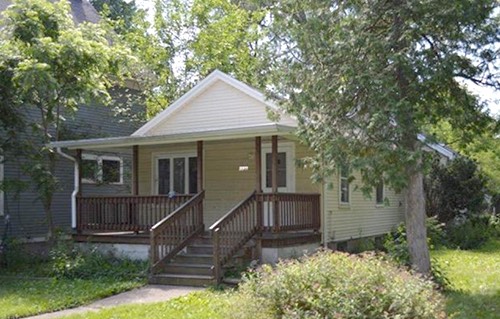 House #1
is a 1930s-era three-bedroom ranch in Ann Arbor, Michigan. This 831
square-foot beauty has a wonderful backyard, and includes a two-car
garage. While the interior needs some love, the house is a deal at a
listing price of just $135,000. So who can afford this house? Peter
& Sally C., Mary P. and Mark Z.
Analysis: All three of
our homebuyers can afford this one. For Mary P. and Mark Z., who can
both afford a 20% down payment (and then some), the monthly payment will
be around $800, well within their respective budgets. The math is a
little trickier for Peter and Sally, but it still works out. They can
afford to make a down payment of $7,000, just over 5% of the home value,
which means they’ll need a mortgage of about $128,000. In Ann Arbor,
their mortgage, tax and insurance payments will be around $950 dollars a
month. That, combined with their debt payments, adds up to $1,200 – or
around 34% of their income.
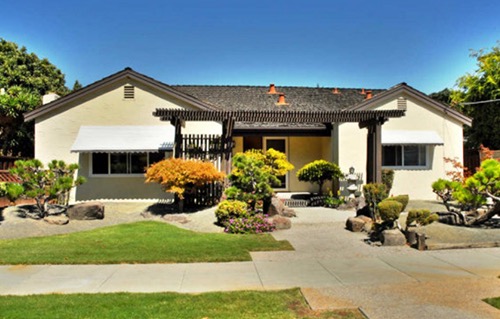 House #2
is a 2,100 square-foot architectural masterpiece in San Jose,
California. Built in 1941, it sits on a 10,000 square-foot lot, and has
three bedrooms and two bathrooms. It’s listed for $820,000, but could
probably be bought for $815,000. So who can afford this house? Mark Z.
Analysis:
While this one’s a little outside of our other homebuyers’ price range,
Mark Z. can make it happen. Using the 36% rule, Mark’s monthly housing
budget is around $14,000. The mortgage, property tax and insurance on
this property will total somewhere around $4,100 – so he could actually
afford to pay more on a monthly basis. For a house this expensive,
lenders require a larger down payment—20% of the home value—so Mark Z.
is limited to a house worth five times his savings (minus that cash
reserve equaling three months’ payments).
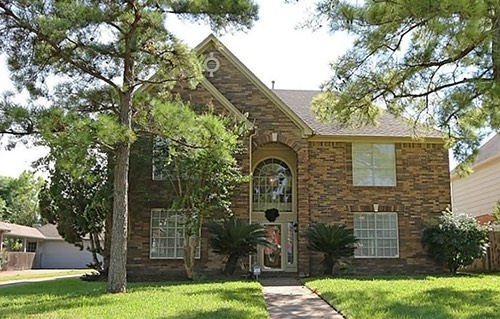 House #3
is a two-story brick cottage in Houston, Texas. With four bedrooms and
three baths, this 3,000 square-foot gem is the perfect place to raise a
family. And it only costs $300,000! So who can afford this house? Mary
P. and Mark Z.
Analysis: Mark Z. can easily afford this
place, but for Mary P. it’s a closer call. Assuming she makes a down
payment of $27,300, or just under 10%, her monthly housing payments will
be $2,110. Add in the $500 student loan payments she’s making each
month, and you’ve got total debt payments of $2,610, which is exactly
36% of her income. Plus, even after she pays her down payment and all
the closing costs, she’ll have around $7,800 left in savings, enough for
four months’ worth of housing payments.
Can I afford a house? vs. Should I buy a house?
In
our game, even though Mark Z. can technically afford House #2 and Mary
P. can technically afford House #3, both of them may decide not to. If
Mark Z. waits another year to buy, he can use some of his high income to
save for a larger down payment. Mary P. may want to find a slightly
cheaper home so she’s not right at that maximum of paying 36% of her
pre-tax income toward debt.
The problem is that some people
believe the answer to How much house can I afford with my salary? is the
same as the answer to What size mortgage do I qualify for? What a bank
(or other lender) is willing to lend you is definitely important to know
as you begin house hunting. But ultimately, you have to live with that
decision. You have to make the mortgage payments each month and live on
the remainder of your income.
So that means you’ve got to do some
homework (sorry!). The factors you should be looking at include those
about your personal financial situation (income, credit rating, existing
debt, down payment and savings) and external factors (mortgage term,
current interest rates, private mortgage insurance and the local real
estate market). Plugging all of these relevant numbers into a home
affordability calculator (like the one above – check it out!) can help
you determine the answer to How much home can I afford? (It helped Peter
& Sally C., Mary P. and Mark Z.) But beyond that you’ve got to
think about your lifestyle- like how much money that leaves you for
travel, other financial goals, etc. You might find that you don’t want
to buy the most expensive home you can afford.
Some Home Affordability Advice
After
all, there is something to be said for the idea of not maxing out your
credit possibilities. Here’s some advice for Mary – and the rest of us.
If you look at houses that are priced somewhere below your maximum, you
leave yourself some options. For one, you will have room to bid if you
end up competing with another buyer for the house. As another
alternative, you will have money left over for renovations and upgrades
just in case the house needs a little work in order to fully transform
into your dream home.
Perhaps more importantly, however, you avoid
putting yourself at the limits of your financial resources if you
choose a house with a price lower than your maximum. You will have an
easier time making your payments, or (better yet!) you will be able to
pay extra on the principal and save yourself money by paying off your
mortgage early.
Reasons to Postpone a Home Purchase
Along
the same lines of thinking, you might consider holding off on buying the
house. This advice goes for Mark, but it could apply to any of us. The
bigger the down payment you can bring to the table, the smaller the loan
you will have to pay interest on. In the long run, the largest portion
of the price you pay for a house is typically the interest on the loan.
In the case of a 30-year mortgage (depending, of course, on the interest
rate) the loan’s interest can add up to three or four times the listed
price of the house (yes, you read that right!). For the first ten years
of a 30-year mortgage, you could be paying almost solely on the interest
and hardly making a dent in the principal on your loan.
That’s
why it can make a significant difference if you make even small extra
payments toward the principal, or start with a bigger down payment
(which of course translates into a smaller loan). If you can afford a
15-year mortgage rather than a 30-year mortgage, your monthly payments
will be higher, but your overall cost will be drastically lower because
you won’t be paying nearly so much interest.
That sounds great,
but it’s not always the best option either. If the 15-year mortgage puts
you uncomfortably close to your maximum—meaning you won’t have any room
in your budget for emergencies or extras—you could always lock into a
30-year mortgage while making a commitment to yourself to make payments
the size of the 15-year plan unless there’s a financial emergency. If
you go with this plan it’s important to make sure your mortgage terms do
NOT include a penalty for paying off the loan early. This is known as a
pre-payment penalty and lenders are required to disclose it.
So, should I buy a home?
When
it comes to answering the question of How much house can I afford?,
it’s important to remember that the mortgage lender is only telling you
that you can buy a house, not necessarily that you should. Only you can
decide whether you should make that purchase.
Source : https://smartasset.com/mortgage/how-much-house-can-i-afford






 SmartAsset’s mortgage calculator projects that monthly payments on a
$200,000 home with a $160,000 30-year fixed-rate mortgage in Ann Arbor,
Michigan will be $1,206 in year one.
SmartAsset’s mortgage calculator projects that monthly payments on a
$200,000 home with a $160,000 30-year fixed-rate mortgage in Ann Arbor,
Michigan will be $1,206 in year one.  With SmartAsset’s mortgage calculator, you can see how your payments
will change over time. In this example, the total payment grows because
of home appreciation, which lifts property taxes over time.
With SmartAsset’s mortgage calculator, you can see how your payments
will change over time. In this example, the total payment grows because
of home appreciation, which lifts property taxes over time.